
Get started
Get started


Fleet managers face mounting pressure to control fuel costs while maintaining operational efficiency of a fleet of vehicles in an increasingly complex transportation landscape. Finding the best fuel card for your business requires evaluating discount programs that can save money up to $1.85 per gallon on diesel fuel, security features that prevent fraud losses, and acceptance spanning 95-99% of the U.S. network of gas stations where drivers purchase fuel daily.
*Features, pricing, rebates, acceptance, eligibility requirements, and account terms may change and vary by provider, merchant participation, fleet size, account type, and geographic region. Check each provider’s website for the most up-to-date product information.
{{CTA}}

The AtoB fuel cards position themselves as the technology leader among the best fleet fuel cards, offering some of the most aggressive discount structures in the market through its mobile-first approach. The card offers potential savings of up to $2.00 per gallon on diesel fuel and 5¢ per gallon on unleaded gasoline. Still, it requires drivers to use the mobile app to identify participating stations in AtoB's fuel card merchant partner program and maximize fuel discounts.
Key features:
The AtoB system excels for tech-savvy fleets comfortable with mobile app dependencies. The card works at over 30,000 gas stations and 3,000+ truck stops, with an average reported savings of 42¢ per gallon* through optimized station selection. However, maximum fuel discounts require consistent mobile app usage, which may pose a challenge to operations with less tech-savvy drivers.
The fee structure includes a $35 setup cost and monthly charges of $15 for 1-5 Flex cards or $3 per active Unlimited card. Get started with AtoB's fuel savings platform to see real-time discount opportunities in your area and better control costs.
* Average discount of 42¢ refers to realized average savings per gallon of truck diesel across AtoB customer transactions at merchant partner truck stops during H2 2025. The up to discount of $2.00 refers to max realized savings per gallon of truck diesel across AtoB customer transactions at merchant partner truck stops during H2 2025. Average discount of 5¢ off per gallon of unleaded is an average across AtoB customer transactions at merchant partner gas stations during H2 2025.
%20logo.jpg)
Fuelman operates with a subscription-based pricing model that differs from typical business credit cards, offering multiple service tiers with flat monthly costs that vary by account, generally independent of card quantity. This structure may be attractive for large fleets where the fixed account fee is distributed across numerous cards for better expense management.
Service tiers and pricing vary by account type and are subject to change.
The Fuelman mixed fleet card and Diesel Fleet Card offer fuel discounts that vary by fuel type, location, and account tier. Acceptance covers a broad network of gas stations and truck stops, providing coverage for many operations while focusing on discount arrangements at preferred fueling stations.
Pros:
Cons:
Shell's partnership with WEX has updated its fleet card offerings, introducing the Shell Card Business and Shell Card Business Flex to replace previous products. This collaboration combines Shell's retail fuel expertise with WEX's financial infrastructure, aiming to enhance fleet management capabilities and improve expense tracking.
The Shell fleet cards offer fuel discounts at Shell stations that vary by account type, while also extending acceptance to a broad network of U.S. gas stations through the WEX partnership. The Business Flex variant is generally geared toward large fleets, with discount structures and potential additional rebates at designated service stations that vary by program terms.
Notable features:
Both cards offer fee structures that vary by account, along with operational flexibility beyond Shell's geographic footprint. The integration of electric vehicle charging capabilities may position Shell favorably for mixed fleet operations incorporating alternative energy sources.

EFS (Electronic Funds Source) has historically focused on the trucking sector, providing specialized services for over-the-road operations and commercial transportation businesses, with fleet cards designed to help manage expenses.
EFS emphasizes commercial trucking partnerships with networks such as Love's, TA Petro, and other major truck stop chains. The card may offer fuel discounts at participating commercial locations, though discount rates vary by location, account, and fuel volume.
Target market:
The EFS network offers coverage at commercial truck stops, featuring dedicated diesel fuel lanes, commercial-grade fuel quality, and truck-specific amenities that may support long-haul operations. See the difference between AtoB and EFS Fuel Card.

Coast positions itself as a fuel card provider with acceptance anywhere Visa is accepted, providing operational flexibility that may exceed some traditional fuel card networks. The card offers fraud protection features, which may include GPS-based transaction verification and real-time activity monitoring, along with spending controls.
Pricing and features:
Coast's integration with popular fleet management systems may enable automatic odometer data matching and vehicle import capabilities, which can reduce the need for manual data entry. Card availability and associated fees vary by account, offering operational flexibility for businesses with varying fleet sizes and seasonal fuel consumption.
The GPS tracking system may compare transaction locations with vehicle positions to help identify potentially fraudulent activity. Spending limits and real-time alerts can provide additional layers of expense management and security.

Comdata has established itself as a provider focused on trucking-oriented fuel management, with acceptance at a broad network of truck stops, including major chains like TA Petro, Love's, and Pilot Flying J. The card offers fuel discounts to commercial transportation operations, which can help fleet managers manage costs, though savings vary by location and account.
Discount highlights:
Comdata offers both credit-based fleet cards and prepaid Connect Cards, catering to a range of financial profiles within the trucking industry. The prepaid option may provide access to fuel card programs without traditional credit requirements, which can help improve cash flow for some small businesses, subject to eligibility.
Fee structure:
Monthly card fees, setup fees, and network fees vary by account type and are subject to change.
The fee structure reflects specialized services and discount arrangements typical of trucking-focused providers, where fuel savings may offset service costs depending on fuel consumption patterns. For transportation businesses that primarily purchase fuel at truck stops, discount rates can vary relative to monthly fees, and actual value depends on account terms and usage.
RTS Financial is generally geared toward small to medium-sized fleet operations, offering fuel discounts while maintaining fee structures and network acceptance that may suit regional and local businesses seeking to manage expenses.
The card may offer fuel discounts at participating gas stations, with discount rates that vary by location and account, while providing acceptance at major fuel chains nationwide. RTS focuses on delivering value through its pricing structure rather than extensive additional services for expense tracking.
Key benefits:
RTS targets the middle market, situated between large-scale commercial operations and small local businesses, by providing fuel management services that may reduce the complexity and costs associated with enterprise-level providers.
Also read: AtoB vs RTS Fuel Card
WEX operates one of the more extensive fuel card programs in the industry, with broad acceptance across U.S. gas stations and a suite of financial services extending beyond basic fuel management. The company's freight factoring services may create synergies for transportation businesses seeking consolidated financial partnerships and improved cash flow.
Network and pricing:
Network coverage, monthly fees, setup fees, and rebate structures vary by account type and are subject to change.*
WEX's discount programs reflect market segmentation, with rebate structures that vary by usage type and brand-specific partnerships. The tiered approach is designed to cater to diverse customer segments, ranging from small businesses to large fleets, with expense tracking capabilities.
Advanced features:
Customer satisfaction ratings for fuel card programs can vary by source and change over time; check current third-party review platforms for up-to-date ratings.

Motive (formerly KeepTruckin) integrates fuel card services with its comprehensive fleet management platform, providing unified expense tracking, telematics integration, and operational analytics in a single system for better vehicle expenses monitoring.
The Motive approach emphasizes seamless data integration between fuel purchases, vehicle tracking, maintenance scheduling, and driver management systems. This integration eliminates the need for separate systems and manual data reconciliation while providing detailed expense reports.
Integration benefits:
• Automated expense tracking and reporting
• Real-time fleet efficiency monitoring
• Integrated vehicle maintenance scheduling based on fuel consumption
• Unified driver and vehicle management with spending controls
For fleets already using Motive's telematics and fleet management services, the fuel card integration provides operational efficiencies that may justify premium pricing structures and monthly fees.
P-Fleet focuses on providing straightforward fuel management solutions with competitive pricing and minimal complexity, targeting small businesses that seek reliable fuel card services without the need for extensive additional expense management features.
The card emphasizes simplicity in both pricing and usage, providing consistent discount rates at participating gas stations while maintaining transparent fee structures and standard acceptance networks for effective cost control.
Core features:
• Transparent pricing with minimal fees
• Consistent discount rates across the network
• Standard acceptance at major fuel chains and service stations
• Simplified account management and expense reports
P-Fleet appeals to businesses prioritizing simplicity and cost-effectiveness over advanced features or extensive service offerings for fleet management.
{{CTA}}
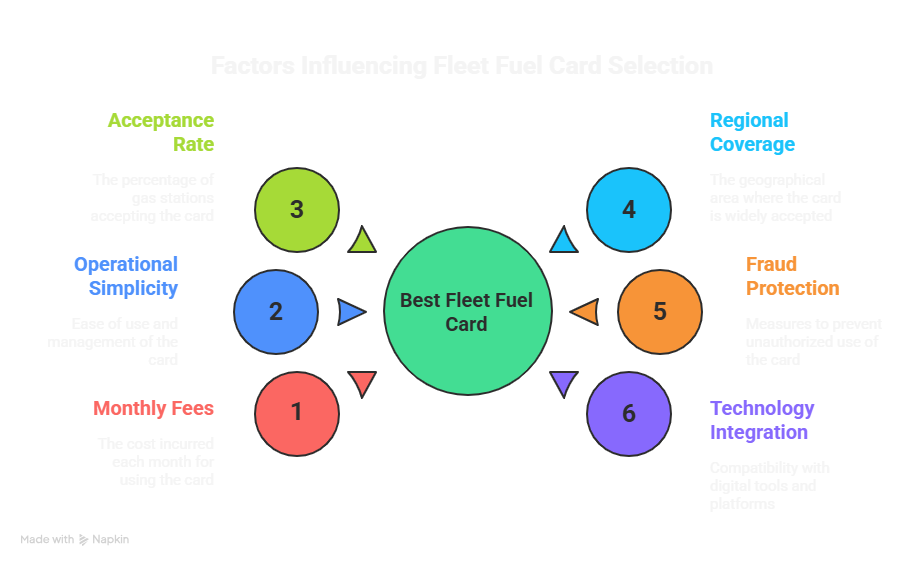
Determining the best fleet fuel cards requires evaluating multiple factors that align with your specific operational requirements, route patterns, and financial priorities. Whether you use the card for gasoline or diesel, fleets should compare fleet fuel cards carefully. The "best" fuel card varies significantly between a local delivery service operating within a 50-mile radius and a long-haul trucking company crossing multiple states daily to purchase fuel.
Essential evaluation criteria include:
Acceptance network coverage represents a fundamental requirement, as even substantial fuel discounts become less useful if drivers cannot purchase fuel when needed. Providers with broader acceptance networks, such as Voyager and WEX, may minimize operational constraints but could offer different discount structures than more specialized providers.
For technology-forward operations, fleet cards like AtoB that leverage mobile apps for discount optimization can provide substantial savings—but only if drivers consistently use the required technology. Traditional operations may find better value in more straightforward card programs, which can provide predictable service with fewer technology dependencies, while helping to control costs.
Cost structure alignment remains important, as the difference between per-card and account-based fees can meaningfully impact total program costs. Annual costs for a given fleet size can vary widely by provider and account type, making fee structure selection an important consideration for small businesses.
Evaluate your fleet's specific requirements by analyzing current fuel spending patterns, route consistency, and operational priorities before committing to any provider.
Fuel discounts vary dramatically among fleet fuel cards, with maximum savings ranging from a modest 3¢ per gallon to an exceptional $1.85 per gallon, depending on provider, location, and operational compliance with program requirements for fuel purchases at participating gas stations.
Highest discount providers:
Universal provider discounts:
The highest fuel discounts typically require operational compromises—either limited station networks, technology dependencies, or specific fueling behaviours. AtoB's exceptional $2.00 per-gallon diesel discount requires drivers to use mobile apps for station selection, potentially limiting operational flexibility for time-sensitive deliveries.
Trucking-specialized providers like TCS and Comdata justify their higher discount rates through partnerships with truck stops that benefit from predictable, high-volume commercial fuel sales. These fuel discounts are often applied specifically to diesel purchases at commercial truck stops, rather than at general retail locations.
Brand-specific cards may provide discounts balanced with operational convenience. Shell's fuel discounts apply at its branded locations, with terms that vary by account type, while maintaining broad acceptance through its WEX partnership—a structure that some fleets find suitable for balancing savings with flexibility.
Evaluating true discount value requires considering:
• Availability of gas stations along regular routes
• Operational time costs of accessing discount locations
• Technology requirements for maximum savings
• Seasonal or regional discount variations
Small businesses face unique challenges when selecting fleet fuel cards, as monthly fees can represent a significant percentage of total fuel costs. At the same time, operational simplicity often takes precedence over advanced features that large fleets require for comprehensive expense management.
Top small business recommendations:
1. Voyager Fleet Card
• Fee structure that varies by account type*
• Wide acceptance across U.S. gas stations
• Simple fraud protection without complexity
2. Circle K Pro Fleet Card
Fee structure that varies by account type*
• Strong regional coverage in Circle K markets
• Straightforward fuel discounts structure
3. AtoB Unlimited Card
• $3 per active card monthly fee
• Technology-driven savings for tech-comfortable operations
• Prepaid structure eliminates credit requirements
Small business evaluation priorities:
Small businesses typically benefit most from fleet cards that eliminate monthly fees, as a $4 monthly charge per card represents $ 48 annually for a 12-card fleet. This substantial cost may exceed fuel discount benefits for lower-volume operations and impact cash flow.
Voyager's fee structure, combined with its broad acceptance, may appeal to small businesses that prioritize simplicity and cost control. The card offers fuel discounts that vary by account and participating location, with generally fewer technology requirements for expense tracking.
For small businesses operating primarily within specific regions, brand-specific cards like Shell may provide optimal value through higher discount rates (6¢ per gallon) while maintaining zero fees and reasonable acceptance within their geographic coverage areas.
Technology-forward small businesses may benefit from AtoB's mobile-driven discount optimization, particularly if drivers are comfortable using smartphones to select stations and maximize savings. However, the $3 monthly fee per active card requires analysis against potential fuel discounts.
Small business owners can evaluate their specific savings potential by analyzing current fuel spending, route patterns, and operational capabilities before selecting a provider.
Fee structures represent one of the most significant cost considerations when selecting fleet fuel cards, with annual costs ranging from $0 to over $4,000, depending on the chosen provider and fleet size, which directly impacts cash flow and expense management capabilities.
Zero-fee options:
Voyager Fleet Card
Shell Card Business/Business Flex
ExxonMobil BusinessPro
Hidden fee considerations:
• Transaction fees: $2-3 per extended network transaction
• Administrative charges: Report generation, research services
• Late payment penalties: Often $75+ or percentage of balance
• Replacement card costs: Typically $2-10 per card
Usage-based billing ensures that businesses only pay for cards with transaction activity within the billing period. This approach benefits fleets with seasonal operations or variable usage patterns where traditional per-card fees may exceed actual utilization.
Volume-based fee structures, provide cost advantages for large fleets while potentially disadvantaging smaller operations through higher per-card rates.
Credit requirements for fleet fuel cards range from no credit checks required to comprehensive financial evaluations that may exclude newer businesses or those with challenged credit histories, impacting their ability to secure business cards. Understanding these requirements is crucial for businesses planning fuel card implementation timelines and effectively managing application processes.
Credit evaluation factors:
Prepaid fuel cards eliminate credit requirements by requiring businesses to load funds before usage; however, this approach may limit credit-building opportunities and necessitate more active cash flow management. The AtoB Unlimited card provides immediate approval capabilities while maintaining access to discount networks and fleet management features.
Credit-based providers typically establish spending limits based on business revenue, credit history, and operational requirements. These limits may start conservatively and increase over time as payment history establishes trust relationships with providers, potentially requiring a personal guarantee.
Some credit-based cards offer credit bureau reporting services that help businesses establish and maintain commercial credit profiles through consistent payment performance. AtoB specifically mentions "free, monthly reporting to Experian to help strengthen your credit profile," providing value beyond basic fuel management services.
Newer businesses or those with limited credit history should prioritize providers offering prepaid options or flexible approval processes while planning longer-term transitions to credit-based programs that provide credit-building opportunities and potentially better discount rates.
Industry-specific providers may offer more flexible credit policies for transportation businesses due to their understanding of industry cash flow patterns and operational requirements. However, credit evaluation standards remain important for establishing appropriate spending limits.
Business owners can explore credit options and approval processes by contacting providers directly to discuss specific circumstances and application requirements.

Selecting the optimal fleet fuel card requires a systematic evaluation of operational requirements, cost considerations, and service priorities that align with your specific business model and geographic coverage needs for effective expense management and fleet efficiency optimization.
Fleet size significantly influences optimal provider selection, with smaller operations typically benefiting from zero-fee or low-fee providers. In contrast, large fleets may justify premium services through operational efficiencies and volume-based savings.
Geographic concentration affects network requirements, as fleets operating within specific regions may benefit from brand-specific cards with higher local discount rates. At the same time, operations crossing multiple states require universal acceptance networks at gas stations.
Driver demographics influence the potential for technology adoption, making mobile-dependent discount programs like AtoB more suitable for tech-savvy operations. At the same time, traditional systems may better serve less technology-oriented workforces.
□ Network coverage aligns with operational routes at service stations
□ Fee structure provides a positive cost-benefit analysis
□ Credit requirements match business financial profile
□ Technology requirements align with operational capabilities
□ Customer service quality meets support needs
□ Integration options support existing business systems
Cards that leverage major credit card networks (Visa/Mastercard), such as AtoB and Coast, may offer broader general merchant acceptance, though their fuel discount programs are typically focused on specific fuel station networks. Traditional closed-loop fleet cards, such as Voyager and WEX, tend to offer more extensive dedicated fuel station coverage through their own specialized partnerships.
Most fleet fuel cards do not require minimum purchase volumes, though some providers and business charge cards offer volume-based discount tiers that provide better rates for higher fuel consumption levels. Fuelman and WEX both offer volume rebates that increase savings for larger fuel purchases, without requiring mandatory minimums.
Specialized trucking providers may have informal volume expectations to justify deep discount rates, but contractual minimum requirements are uncommon. This makes different fleet fuel cards accessible to businesses of all sizes, whether they use a fleet of two vehicles or manage dozens. Small businesses can typically access the same discount programs as larger operations, although per-gallon rates may vary depending on the provider's discount structures.
Specialized trucking providers may have informal volume expectations to justify deep discount rates, but contractual minimum requirements are uncommon. Small businesses can typically access the same discount programs as larger operations, although per-gallon rates may vary depending on the provider's discount structures.
Yes, most modern fleet fuel cards support both gasoline and diesel fuel purchases on the same card system. Fuelman specifically offers a "mixed fleet card" designed for operations running both light-duty gasoline vehicles and heavy-duty diesel equipment.
Providers like AtoB, WEX, and Voyager all accommodate mixed fuel types, offering different fuel discounts for gasoline versus diesel purchases. Some specialized diesel fuel discounts may only apply to commercial diesel grades at truck stops rather than automotive diesel at retail service stations.
Regional operations benefit most from brand-specific cards which offer higher discount rates within their geographic coverage areas while maintaining reasonable backup acceptance through partnerships.
Long-haul operations require universal acceptance fleet cards that ensure consistent fuel availability regardless of route variations. Trucking-focused providers also excel in long-haul operations through extensive partnerships with truck stops and access to commercial-grade fuel.
Multiple providers offer zero monthly fees and eliminate the most significant recurring cost component while maintaining competitive discount rates and broad acceptance networks.
Circle K Pro Fleet Card also provides zero fees but limits acceptance to Circle K locations, making it suitable for regional operations with adequate Circle K coverage along regular routes. Businesses can explore fee-free options while evaluating the total cost of ownership, including potential fuel savings.
Same-day approval availability varies by provider and credit requirements. Prepaid cards, such as AtoB Unlimited, typically offer immediate approval since they don't require credit checks, whereas credit-based cards may require 1-3 business days for a financial evaluation.
Coast emphasizes streamlined approval processes, while traditional providers typically require standard commercial credit evaluation timelines. Businesses requiring immediate access should prioritize prepaid options or contact providers directly about expedited processing for urgent operational needs.
Seasonal fleets can optimize costs through usage-based fee structures which only charges for cards with transaction activity within billing periods. This approach eliminates monthly fees during non-operational seasons while maintaining card availability for peak periods.
Fixed-fee providers, such as Fuelman, may be less suitable for seasonal operations, as monthly account fees continue regardless of usage levels. Zero-fee providers, such as Voyager, offer consistent value for seasonal operations, eliminating ongoing costs during periods of low activity.
AtoB and Coast offer integration capabilities through modern API architectures and partnerships with telematics providers like Samsara. These fleet cards may offer automated data sharing, which can reduce the need for manual expense tracking and support fleet management analytics.
Other providers may require third-party integration solutions or manual data import processes to connect with fleet management systems, depending on the platform.
The best fleet fuel cards offer variations in discount rates, fee structures, and operational requirements, making careful selection of the provider crucial for cost optimization and operational efficiency. When you compare fleet cards, focus on total value: savings, controls, and scalability. Voyager's fee structure and broad network acceptance* provide the foundation for cost-conscious operations. Meanwhile, AtoB's technology-driven approach offers savings potential of up to $2.00 per gallon for fleets that adopt mobile optimization.
Success requires matching provider capabilities to operational realities—universal fleet cards, such as WEX, serve diverse operations that require maximum flexibility, while specialized providers, like Comdata and TCS, may offer added value for trucking-focused businesses willing to optimize routes around preferred networks.
Businesses ready to optimize their fuel management should evaluate providers based on total cost of ownership, route compatibility, and long-term operational requirements rather than focusing solely on advertised discount rates.
{{CTA}}
Citations:
[1] American Transportation Research Institute. (2024). "Fleet Operating Cost Analysis." https://truckingresearch.org/
[2] Federal Motor Carrier Safety Administration. (2024). "Commercial Vehicle Fuel Efficiency Standards." https://www.fmcsa.dot.gov/
[3] WEX Inc. (2024). "Fleet Card Network Analysis." https://www.wexinc.com/
[4] Coast Financial. (2024). "Fleet Fuel Card Market Report." https://coastpay.com/
[5] Fuelman Fleet Services. (2024). "Commercial Fuel Discount Programs." https://www.fuelman.com/

.jpg)